Federal Eviction Moratorium Extended 60 Days
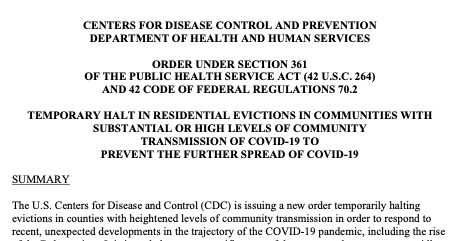
The Biden Administration reversed course Tuesday by issuing a new, more limited federal eviction moratorium that will remain in effect until October 3, 2021.
The President had previously said he didn't have the authority to extend the moratorium and that any further declaration must come from Congress.
The Centers for Disease Control and Prevention posted the announcement on its website Tuesday night. The moratorium is more limited in scope, covering renters only in counties across the country that the CDC deems the spread of COVID as "substantial" or "high".
This includes the majority of counties, including Philadelphia, which is listed as "substantial". Bucks, Montgomery, and Delaware Counties are also "substantial".
Chester County is currently listed as "moderate".
Stay with Hapco Philadelphia for more on this developing story.


Member Profile: Time To Sell?
Landlord Kenyatta Moore says only the City of Philadelphia can save him.

It is almost like City Council is confessing to killing off affordable rental housing in Philadelphia.
At least, that’s how Hapco Philadelphia member Kenyatta Moore sees the release of a recent study from the Urban Land Institute.
The report was commissioned by the city’s housing department and urges city council to view small mom and pop landlords as small business owners when rental housing laws and fees are enacted.
“I have all the expenses that a small business has but without the financial help and guidance that they get,” says Moore, who owns two rental properties in the Olney section of Philadelphia.
Moore bought his affordable rental properties with the intention of being a landlord for ten to twenty years. But he finds the COVID-19 pandemic, endless eviction moratoria, and city emergency tenant laws are forcing him to sell out.
“One of my tenants stopped paying rent during the pandemic and refused to apply for emergency rental assistance. Eventually, I got a lockout, and the tenant broke in and changed the locks again.”
Moore says the city seems to assume that all rental property owners are large, wealthy landlords who can absorb every cost. He says they need to realize there is a big difference between affordable rental housing and market rate properties.
“City Council lumps small and large landlords together. They should pay attention to us mom and pops and the rental demographics of the city.”
The Urban Land Institute study says defining small and large rental property owners is one of the keys to keeping affordable housing from disappearing altogether.
Moore would like to see more financial help and education from the city for small landlords and their tenants. He would also like the city to connect mom and pop rental property owners with small landscaping and handyman businesses to help maintain low to moderate income properties.
“The city tends to favor the tenants over the landlords and some tenants know that and game the system,” Moore says. “Tenants feel protected no matter how much the renter is to blame for their situation.” Moore says the city has a responsibility to educate tenants that they are partners with their landlords, not adversaries.
Kenyatta Moore says if he is forced to sell his rental properties, that’s four more low to moderate income apartments that disappear from the market. “Who’s going to replace those units?” he adds.
“We all play a role in saving affordable housing in Philadelphia,” Moore notes. “I just hope City Council gives me a fighting chance to save mine.”

Survey Says... (Results of Our Membership Survey)
Who are your fellow Hapco Philadelphia members? Our first membership survey reveals some interesting findings.

Hapco Philadelphia is into its seventh decade of existence; promoted in the 1960’s as a “mom and pop” landlord organization. So … are we still “mom and pop”? Today, in these challenging times, we’re more committed than ever to representing mom, pop, and everyone else who invests or manages rental property in the City of Philadelphia. But good representation, of course, mandates that we know who we’re representing. That’s why we asked our members (and even non-member landlords) to complete the first in a series of non-scientific surveys to learn more about Philadelphia investment property owners and managers. This first survey was completed by 253 people, and all but four identified themselves as Hapco Philadelphia members. In fact, 57% say they’ve been a member for at least seven years.
Two hundred fifty-three responses isn’t a majority of our membership, of course. But it still offers us some insights that may interest you about your peers.
For starters, about 59% of the respondents were men, 41% women, and more than half (53%) are 61 years old or older. Like most organizations, we want to attract more young people, and we’ve got some work to do: only 2% are age 35 or younger! Know of younger Philadelphia landlords? Tell them to join us. As one member wrote on the survey, “HAPCO has really stepped up its game. Love it!” Thanks for your kind words. Now, back to the survey:
98% of those who responded own rental property, and 85% own single family or duplex units. About a third own triplex properties. Nearly 7% own multi-family properties that house twenty-one or more units.
So how many units do our members own or manage? About 42% of respondents told us they have one to four units. 23% own five to ten, and more than 12% own 51 or more units.
As for rent, half say they charge between $1,001 - $1,400 per month. 25% charge $750 or less, and 16% charge $2,001 or more.
About 49% of those surveyed have annual revenues from their properties of $50,000 or less. About 36% have annual revenues between $50,001 and $250,000, and about 15% have revenues of at least $250,001 per year.
Ninety-four percent classify all or some of their properties as market-rate, and 28% offer Section 8/Voucher Assistance housing.
As to where members own, we should first acknowledge a mistake that many of you caught. Yes, we inadvertently forgot to include Northwest Philadelphia. (Crazy, right?, considering some of our board members have property there!) In any case, we found that our members own pretty evenly across West Philly (35%) North Philadelphia (34%), the Northeast (32%) South Philly (23%) and Center City (21%). And about 28% also own property outside the city. Finally, about 45% of those responding say they live in the city themselves.
Are tenants paying their monthly rent? Respondents say, on average, they successfully collect about 87% from occupied units.
These are some of the highlights from our first membership survey. Over the next several months, we’re planning additional surveys focused on issues and concerns our members may have. We encourage you to participate, because your input matters!
Hapco Philadelphia Among Housing Advocates Nationwide Invited To Attend White House Summit

Hapco Philadelphia Board Member Victor Pinckney, Sr. participated in a virtual White House Summit that sought input on how to speed the distribution of federal Emergency Rental Assistance funds.
With the CDC’s eviction moratorium set to expire in just days, on July 31, the Biden Administration is exploring ways to streamline the process of getting overdue rent payments into the hands of landlords, hoping to prevent an anticipated avalanche of evictions in the coming months.
Two separate White House Summits included presentations from a variety of city mayors, judges and housing advocates on eviction diversion programs and other processes that local municipalities and courts have found effective. “We have a responsibility to do everything we can. Every preventable eviction is a preventable heartbreak for families,” said Gene Sperling, who oversees COVID-relief funding for the White House. Distributing billions of dollars to qualifying tenants to pay landlords has been an enormous undertaking, because a national distribution infrastructure is not in place, leaving many lower-income tenants and small “mom and pop” landlords unaware of the available funding. But distribution is improving. In June, more than 290,000 families were assisted, with $1.5 billion dollars distributed, three times more than in April. But with the moratorium expiring, the government is racing to distribute a record amount of funds in August and September, trying to beat the anticipated eviction onslaught. Housing advocates nationwide shared their success stories. For example, Stay Housed L.A., a community partnership agency in Los Angeles, has assisted more than 200,000 tenants and landlords by offering education, legal assistance and creating a one-stop-shop website that directs landlords and tenants to apply for emergency rental assistance. Similar programs have been established across the country, including Philadelphia’s one-stop-shop site at phlrentassist.org. Through July 2, Philadelphia has served more than 22,000 households and provided more than $100 million in financial assistance to pay rent and utilities. Still, the approval rate in the latest phase of city funding only sits at 60%, and with about $90 million dollars still available, Philadelphia could forfeit money to another municipality if additional landlord and tenant recipients are not identified soon.
Part of the problem in Philadelphia is that a landlord cannot move forward on a funding application without the consent of the tenant, and some tenants are uncooperative. Hapco Philadelphia Board Member Victor Pinckney, Sr. says that needs to change. He participated in a White House Summit breakout session that included Philadelphia’s Landlord Tenant Judge Matthew Wolf. Pinckney says a productive conversation led to a scheduled upcoming meeting with the judge to discuss L&T court policy and another meeting with Greg Heller, Executive Director of the Philadelphia Redevelopment Authority (PRA), to discuss emergency rental assistance fund distribution before time runs out. PRA is the city’s implementation arm for community development and affordable housing finance.
In the meantime, any Philadelphia landlord who is owed past-due rent from a tenant due to a COVID-related financial hardship is urged to immediately apply for emergency rental assistance at phlrentassist.org.
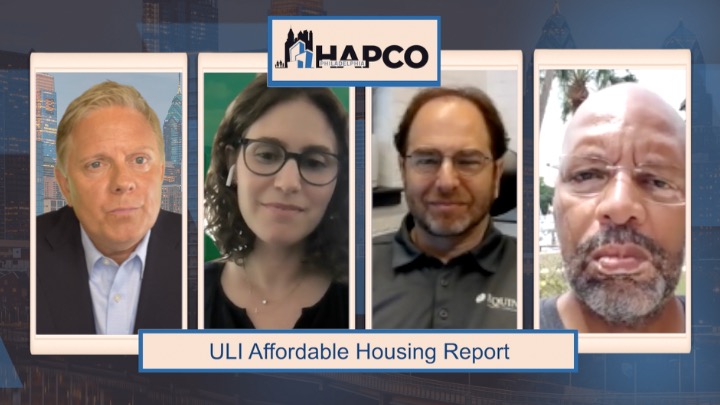
HAPCO Philadelphia Video: Future of Affordable Housing Requires City to Better Communicate With Landlords
A HAPCO Philadelphia VIDEO: The City of Philadelphia must treat small landlords more like business owners and nurture their development, because the future of affordable housing is at stake.
These are among the findings of a new report by the Urban Land Institute that was commissioned in part by the city. Two members of the panel that authored the report sit down with HAPCO Philadelphia to explain why the city's relationship with its small landlords must improve.
Hapco Video: City Must Help Landlords To Avoid Housing Crisis
Note: This story was written from an interview Hapco Philadelphia conducted with several of the housing advocates who created this report. To watch the interview and learn more, scroll down.
A new study by the Urban Land Institute (philadelphia.uli.org) finds that the City of Philadelphia must dramatically improve its relationship with city landlords or devolve into an affordable housing crisis. The report, sponsored in part by the city, investigated why “naturally occurring affordable housing”, defined as affordable non-subsidized housing, is “in crisis”.
“We are already what’s considered to be in crisis in terms of having housing that’s affordable for most people in the City of Philadelphia. Over 50% of the City of Philadelphia’s residents have housing costs that exceed 30% of their income, and I believe over 30% of the City’s residents have housing costs that exceed 50% of their income. It will only get worse unless we find better solutions,” says Jonathan Weiss, a volunteer panelist in the study and 20-year Hapco Philadlephia member.
At the heart of the solution are Philadelphia “mom and pop” landlords. Weiss says 65% of housing that is “naturally affordable” is owned and operated by small landlords with five units or fewer.
Jim Burnett, Executive Director of VestedIn, which provides capital and resources to support Philadelphia businesses, says the City must treat small landlords not just as property owners but as business owners. Burnett also volunteered as a panelist in the study.
“Where we see these small landlords is literally as if they were running a business. Essentially, they’re making an investment in property. Their property then needs to have continual support services. And around Philadelphia, there are literally tens of business support organizations but very few of them provide that type of support for small landlords,” Burnett tells Hapco Philadelphia.
Weiss compared Philadelphia to another large city. “If you Google ‘landlord training programs’ with the City of Chicago, there’s a variety of training programs they have where they bring in the police department, L&I and social services groups to help landlords understand what it means to be a provider of housing and how to negotiate it. If you Google-search “City of Philadelphia landlord training programs”, you’re going to come up with a list of requirements and licenses and regulations that you need to meet. It’s just a very different philosophy. There’s all kinds of well-intentioned regulatory pieces, but it’s set up as obstacles, not as a way to help this group of people.”
And the pandemic only made a bad situation worse. “It’s tough to be in a position where your customers are not required to pay you, but you’re required to continue providing services to them. There was some rental subsidy money the federal government made available, but it was very complicated to access. I experienced it firsthand,” Weiss said.
They agree the city would be better served by providing small landlords with funding opportunities for repairs rather than pour money into inefficient red-tape subsidy programs.
“It’s really redirecting resources. I think the city is interested in exploring ways to do it,” Weiss says.
Burnett believes the time is now. “People are listening, but we only have a small window of opportunity before people start to go back to their normal habits. But if we can catch them now with the right support systems, I think we can get a lot of change within the city.”
It starts with getting all stakeholders to read the ULI report, says Laura Slutsky, Executive Director of ULI Philadelphia.
“The point of this is to consider these naturally-occurring properties that currently are not subsidized and not regulated as part of our affordable housing stock and the owners as part of that universe. Today, there’s just not as built-in of an infrastructure like there is on the subsidized side to support for capital streams, for repair programs to maintain the housing quality. And so the hope is that by starting to focus on these property types, we can bring a focus that these properties are part of the city’s affordable housing preservation strategy.”
Study panelists included both national and local affordable housing advocates. The Urban Land Institute is a non-lobbying agency that does housing policy work in partnership with the public sector. It has 45,000 members worldwide, including 900 in the Philadelphia region.