


Rent Control, COVID Evictions, and Insurance Losses: Here's What's Happening in Harrisburg
Pennsylvania lawmakers are considering at least eighteen pieces of legislation that may impact landlords. There's good and bad.

They run the gamut, from a prohibition on rent control to rules on eviction and late fees during COVID-19 and future pandemics.
Another says a security deposit cannot be characterized as "non-refundable". And yet another would allow COVID-related financial losses as an insurable policy claim in 2020.


How Might President Biden's "American Families Plan" Affect Landlords?
The Senior Vice President of Government Affairs for the National Apartment Association weighs in.
President Biden presented his "American Families Plan" in a speech this week to a joint session of Congress. The NAA's Greg Brown has a few takeaways.

Changes Coming to Philly's Bed Bug Law?
If you, as a Philly landlord, are bugged over the city’s new bedbug law, you’re not alone. But the good news is that change may be coming.
Several Philadelphia City Council members recently teamed up with Licenses and Inspections to lead a bed bug Q&A for landlords. The lawmakers heard an earful. In fact, three city council members promised to look into the possibility of re-writing all or part of the new law.
The city’s new bed bug ordinance was signed at the end of 2019 but became law this past January first. It requires landlords to:
- develop a written bed bug control plan,
- give tenants the city’s bed bug brochure prior to a new lease, and
- inform the tenant in writing prior to a new lease if the unit had a bed bug infestation in the previous 120 days, along with steps taken to remediate it.
Should a landlord receive a bed bug complaint from a tenant, the landlord must then:
- acknowledge the complaint in writing within five days,
- bring pest management to the unit within ten days,
- and, if infested, quickly remediate the unit until given the all-clear.
- In buildings with four or more units, all adjacent units must also be investigated, including those above and below.
A tenant’s responsibilities include not knowingly bringing items into a unit infested with bed bugs, notifying the landlord in writing within five days of an infestation, and cooperating with pest management during its investigation and remediation.
According to L&I’s Sarah Adamo, who attended the meeting, the landlord is responsible for the full cost if the infestation is reported within one year of move-in. After a year, the landlord and tenant share the cost.
Many landlords say the new law seems to heavily weigh in favor of the tenant, who may have caused the infestation in the first place.
“Why can’t I pay for a professional exterminator to declare the property bedbug-free prior to occupancy, so that I’m not responsible later?” asked one attendee. Another said she had fully renovated her property, which was built with new materials. “I know for a fact my place is bedbug free. If a tenant brings in bedbugs to my brand new property and I am being held responsible, it’s a very unfair system.” A third asked, “Why shouldn’t landlords be free of responsibility after sixty to ninety days? There’s no fairness in just holding the landlord responsible with fines or a loss of license.”
City Councilman Mark Squilla originally proposed the bill. His Legislative Assistant, Sean McMonagle, attended the meeting, saying “it’s hard to determine the origin of infestation, so we’re trying to split the issue down the middle and trying not to put blame on either party.”
It wasn’t what landlords wanted to hear.
Three council members in attendance, Katherine Gilmore Richardson, Derek Green, and Allan Domb appeared very receptive to revising the ordinance.
“We are committed to following up with our colleagues to bring forth these suggestions to ensure that we adequately represent all of the concerns as an opportunity to explore amendments,” Gilmore Richardson said.
And McMonagle responded, “We are absolutely prepared to work with the other members of council to amend this bill. We could propose an entirely new bill if that’s the best course.”
So there is hope for change. But remember: as of now, the current bedbug ordinance is in full effect.
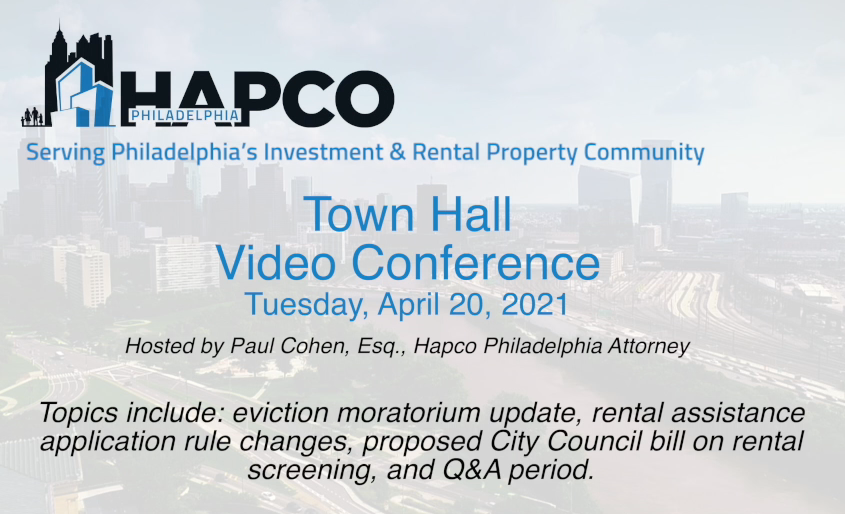
Watch: HP Town Hall on Eviction Rules, Financial Assistance and Tenant Screening
HP Attorney Paul Cohen discusses changes to the Emergency Rental Assistance Program & a bill that would limit the information landlords can use to screen potential tenants.
Philadelphia’s Emergency Rental Assistance Program is now up and running. But not following the sometimes complex and ambiguous rules could cost you time and money. Rules and timelines seems to regularly change, so the faster you apply, the faster you’ll get paid.
This HAPCO Philadelphia Town Hall, recorded on April 20, 2021 and led by HP Attorney Paul Cohen, will answer most of your questions.
Also discussed: a bill in Philadelphia City Council that would limit the documentation landlords may consider as criteria for screening potential tenants.

Debt Collectors Can Be Held Accountable for Illegal Evictions
While the CDC's national eviction moratorium stands, a policy clarification says debt collectors who don't advise tenants of their rights could face prosecution.
The new rule by the Consumer Financial Protection Bureau (CFPB) requires debt collectors to provide written notice to tenants of their rights and cannot misrepresent those rights. Phone calls, text messages or emails are not sufficient.
The Moratorium imposed by the Centers for Disease Control and Prevention currently runs through June 30, 2021.